A Dangerous Idea: How the Scopes Trial Still Shapes Our World
An Interview With Award-Winning Author Debbie Levy
Debbie Levy received a 2025 Grateful American Book Prize Honorable Mention for her A Dangerous Idea: The Scopes Trial, the Original Fight over Science in Schools. This award-winning work chronicles the century-old debate sparked by John T. Scopes, a small-town science teacher whose prosecution for teaching evolution torched a national controversy about what students should learn.
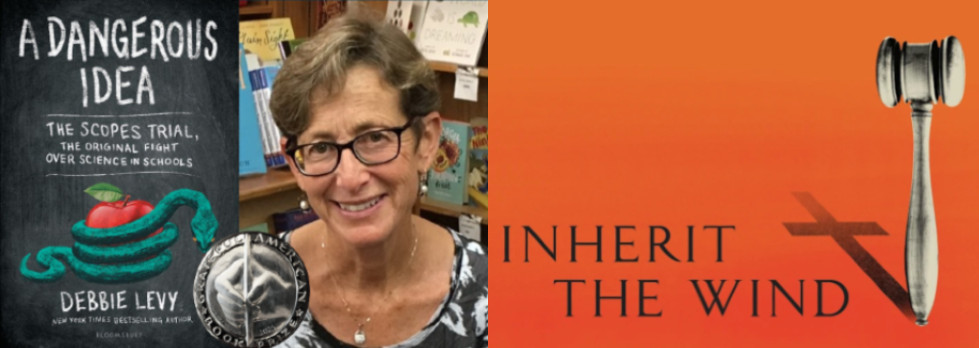
Levy’s book is not just a historical account—it draws powerful connections between the past and present, revealing how the campaign against scientific knowledge and the rejection of uncomfortable facts continue to shape public discourse.
In this interview Levy reflects on how the Scopes Trial can be seen in current debates about education, science, and truth, reminding readers that the struggle to balance knowledge, belief, and critical thinking in schools is as urgent now as it was a hundred years ago.
Have kids ever heard of John T. Scopes? Is he studied in school?
Some kids have, sure. Some adults, sure. But I don’t think Scopes or the trial is universally known. As for whether the trial is studied in school, I haven’t done a survey, but again I’d say—in some schools.
I think this is one of those stories that has been gradually fading from the public consciousness. For a writer like me, this is what made it an irresistible story to share. It’s about the people, passions, and ignorance that led, in the summer of 1925, to the prosecution of a teacher in Tennessee for the crime of teaching evolution. It’s about how the campaign against knowledge—and its aftermath—reverberate.
But apart from these top-line narrative arcs, readers see how badly adults can behave when they want to keep young people in the dark about the real world. They meet a first-year teacher, John Scopes, not much older than they are, volunteering to be prosecuted. Readers are in the stifling courtroom to witness a trial gone completely, and frequently hilariously, off the rails.
Readers also encounter nuance, and while I don’t like to anoint a theme in my own book “important”—I do think nuance, a cousin to empathy, is so important. There is nuance in seeing how ordinary people as well as luminaries defy expectations of what villains and heroes are about. I draw these contrasts in sharp relief, because I want my readers to understand that our world is rarely black and white.
How does the public access information about current events today, and how does this compare to the media spectacle surrounding the trial a century ago?
The bad news about news gathering today is that influencers and social media and celebrities have become such prominent sources of “information” — quotation marks definitely emphasized here! In this ecosystem the quest for clicks and fame too often outweighs the search for any kind of truth. I’m a big fan of curated sources of information — print, video, audio, and digital outlets with reporters and fact-checkers and editors who work to get a story as accurate as it can be. They are the brights lights in today’s journalism.
But I won’t deny that, as the Scopes trial shows us, traditionally curated sources don’t guarantee good information. The newspapers of 1925 often got things wrong and served up stories that seemed either designed to rile up their readers or to disparage the people they knew their audience already scorned. I’d take a news ecosystem bursting with professional journalists vying for scoops and stories over professional influencers vying for clicks any day
audience already scorned. I’d take a news ecosystem bursting with professional journalists vying for scoops and stories over professional influencers vying for clicks any day.
What do you consider the most significant and relevant aspect of the historic event featured in your book?
I’ll go back to the theme of “nuance” that I just mentioned — how important it is to recognize nuance, how it complicates easy answers, and how lacking it can be in public conversations about important questions. Let’s consider William Jennings Bryan, for example, the demagogue behind the anti-evolution campaign that swept the nation in the early 1920s. 60 million people, out of a total U.S. population of 110 million, had heard him speak. He had a huge following that any social media influencer today would envy. Bryan misled his followers about what evolution meant, what a scientific theory was. He conjured this nonexistent conspiracy of scientists and teachers who wanted to make atheists of America’s children.
But there’s no denying that Bryan’s religious beliefs were sincerely held! He really was trying to save the souls of the nation’s youth! He truly believed that evolution promoted killing off the weak in favor of the strong.
This kind of adversary is harder to come to terms with than a purely evil or purely ridiculous one. I want readers to grapple with this. I certainly did in writing my book. And this kind of adversary creates waves that don’t just crash onto the shores of history and die, but that resound over space and time.
And so, readers will recognize in the world around them today the wave rings that originated 100 years ago. There are the false narratives. Then: Teaching evolution to kids = teaching them not to believe in God. No. It’s not. Now: books presenting historical truths about racism in America “teach our kids to hate this country or hate each other.” I am quoting someone there. No. They don’t.
Another wave ring: ridicule of expertise, especially science and scientists. Then: In one of his standard speeches, Bryan always said, “The word hypothesis is a synonym used by scientists for the word guess.” No. It’s not. This was his way of maligning science, which is based on — testing hypotheses.
Now: During the pandemic our president called scientists “idiots” because, in response to data, they shifted their recommendations on how to respond to the public health crisis. In other words, they used the scientific method.
I’ll mention one more reverberation: rejection of facts because they make some people uncomfortable. The fact of evolution was new to the parents of the early 1900s, and new can be uncomfortable. Don’t teach that stuff to my children! Today, teaching about climate change suggests that human beings should change their behaviors. That’s an uncomfortable idea. So climate change becomes a hoax.
I hope my readers grapple with all of this. This is the world they are inheriting. I think what happened in 1925 with evolution, and in the decades following, provide them with some guideposts.
Arena Stage is collaborating with An Open Book Foundation and you to share A Dangerous Idea with some students attending their production of Inherit the Wind in March 2026. Through this partnership, students will receive their own copies of the book, and you will work with theater creatives to deliver post-show presentations at several schools. How do you hope these activities will educate students who attend the live production?
The play is riveting and whatever the theater people do at the post-show events will be fabulous, I am sure — because they are *theater people*! My plan at the post-show presentations is to focus on and surprise students by drawing attention to elements of the story as portrayed in the play that are fictional — and how those elements actually played out in real life. I think that by looking at some of these discrepancies we’ll touch on the “nuance” piece and the wave rings I mentioned earlier.
What is your next project for young readers?
I have a picture book coming out next year, titled Once We Were Strangers. It’s about the Jewish tradition, passed down through generations, of caring for and protecting the stranger. My mother was a refugee from Nazi Germany, so this story is very close to my heart. So is another project that I’m working on, which is a graphic novel-style nonfiction book that tells the exciting and poignant story of my father’s service as a medical corpsman on a warship in WWII. His story illuminates corners of that war that are underrepresented in books for young people, as well as other themes that are important to me.
Learn more about the New York Times Best Selling author and her books for readers of all ages on her website.