November 1 — November 15, 2026
History Matters
Showing our children that their past is prelude to their future, with book recommendations
. The Election of 1800
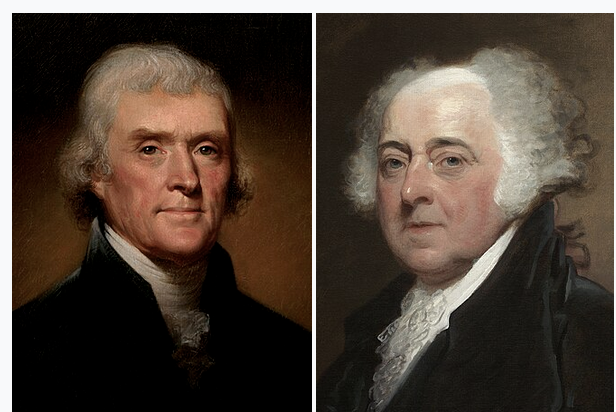
The Election of 1800 was the defining political contest in the early American republic, setting Federalist incumbent John Adams against Democratic-Republican, Thomas Jefferson. Partisan tensions had fired up over the Quasi-War with France, the Alien and Sedition Acts, taxes, and the proper scope of federal power. While Adams favored closer British ties and a stronger military, Jefferson preferred limited government, a focus on agrarian interests, and more affable relations with France. The campaign was distinguished by fierce personal attacks; the Federalists accused Jefferson of being an atheist and dangerous radical, and the Republicans branded Adams as a would-be monarch.
Voting for electors began in November of 1800 in some states—but not all—there wasn’t a uniform Election Day—yet. However, each set a date within a window fixed by Congress, and the nominators cast their ballots: Adams with Charles Cotesworth Pinckney; Jefferson was paired with Aaron Burr.
The lame-duck Federalist House deadlocked for 35 ballots between February 11 and 17, 1801. Many Federalists preferred Burr, but Alexander Hamilton’s strong opposition to him proved to be decisive. On the 36th ballot, enough Federalists abstained to give Jefferson most state delegations (10–4). As the runner-up in the House election, Burr was elected vice-president, just as his party had originally planned. Jefferson was inaugurated on March 4, 1801, at the unfinished Capitol in Washington, D.C where, he sought unity by declaring, “We are all republicans, we are all federalists.”
Jefferson later called the outcome the “Revolution of 1800,” the first peaceful transfer of power between opposing parties. It ended Federalist control of the presidency and Congress, confirmed the legitimacy of the two-party system, and exposed flaws in the electoral process that led to the Twelfth Amendment (ratified 1804), requiring separate ballots for president and vice president.
For more information, the Grateful American Book Prize recommends John Ferling’s Adams vs. Jefferson: The Tumultuous Election of 1800.
Michael F. Bishop, a writer and historian, is the former executive director of the International Churchill Society and the Abraham Lincoln Bicentennial Commission.
History Matters is a feature courtesy of the Grateful American Book Prize, an annual award for high quality, 7th to 9th grade-level books dealing with important events and personalities in American history.