November 16 — November 30, 2026
History Matters
Showing our children that their past is prelude to their future, with book recommendations
. Lincoln at Gettysburg
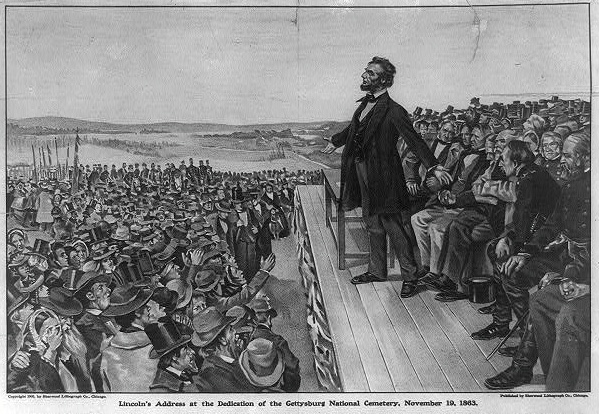
On November 19, 1863, President Abraham Lincoln delivered a speech at the dedication of the Soldiers’ National Cemetery in Gettysburg, Pennsylvania—four months after it had been the site of the bloodiest battle in the Civil War.
Fought between July 1–3, 1863, the Battle of Gettysburg had turned back Confederate General Robert E. Lee’s invasion of the North, and cost the North and South the lives of about 7,000 troops, combined. Afterwards, Pennsylvania established a national cemetery for the Union dead. On that day, the featured speaker was the renowned orator Edward Everett, whose formal address lasted nearly two hours. Lincoln, in contrast, who was invited to offer “a few appropriate remarks,” delivered an address of roughly 272 words that lasted about two minutes before a crowd of about 15,000.
Beginning “Four score and seven years ago,” Lincoln dated the nation’s birth not to the Constitution, but to the Declaration of Independence of 1776 and its assertion that all men are created equal. He framed the war as a test of whether a nation so conceived could long endure. Rather than dwelling on military details, he argued that the living could not truly consecrate the ground, as the fallen had already done so by their sacrifice, and that the living must instead dedicate themselves to the unfinished work: ensuring that those dead “shall not have died in vain,” that the nation would experience “a new birth of freedom,” and that “government of the people, by the people, for the people, shall not perish from the earth.”
Contemporary reaction was mixed. Some newspapers dismissed the remarks as inadequate, and Lincoln—reportedly—feared the speech had failed, but Everett, later wrote that Lincoln had expressed the central idea of the occasion more effectively in two minutes than he had in two hours. Over time, the address was recognized as a masterpiece of compressed rhetoric and a defining statement of American purpose. By linking the Union cause to the principle of equality and redefining the war as a struggle for a “new birth of freedom,” Lincoln shifted the moral stakes of the conflict and helped shape how later generations understood the Civil War and the meaning of American democracy. It is inscribed in the Lincoln Memorial and is among the most quoted speeches in American history.
For more information, the Grateful American Book Prize recommends Gabor Boritt’s The Gettysburg Gospel.
Michael F. Bishop, a writer and historian, is the former executive director of the International Churchill Society and the Abraham Lincoln Bicentennial Commission.
History Matters is a feature courtesy of the Grateful American Book Prize, an annual award for high quality, 7th to 9th grade-level books dealing with important events and personalities in American history.